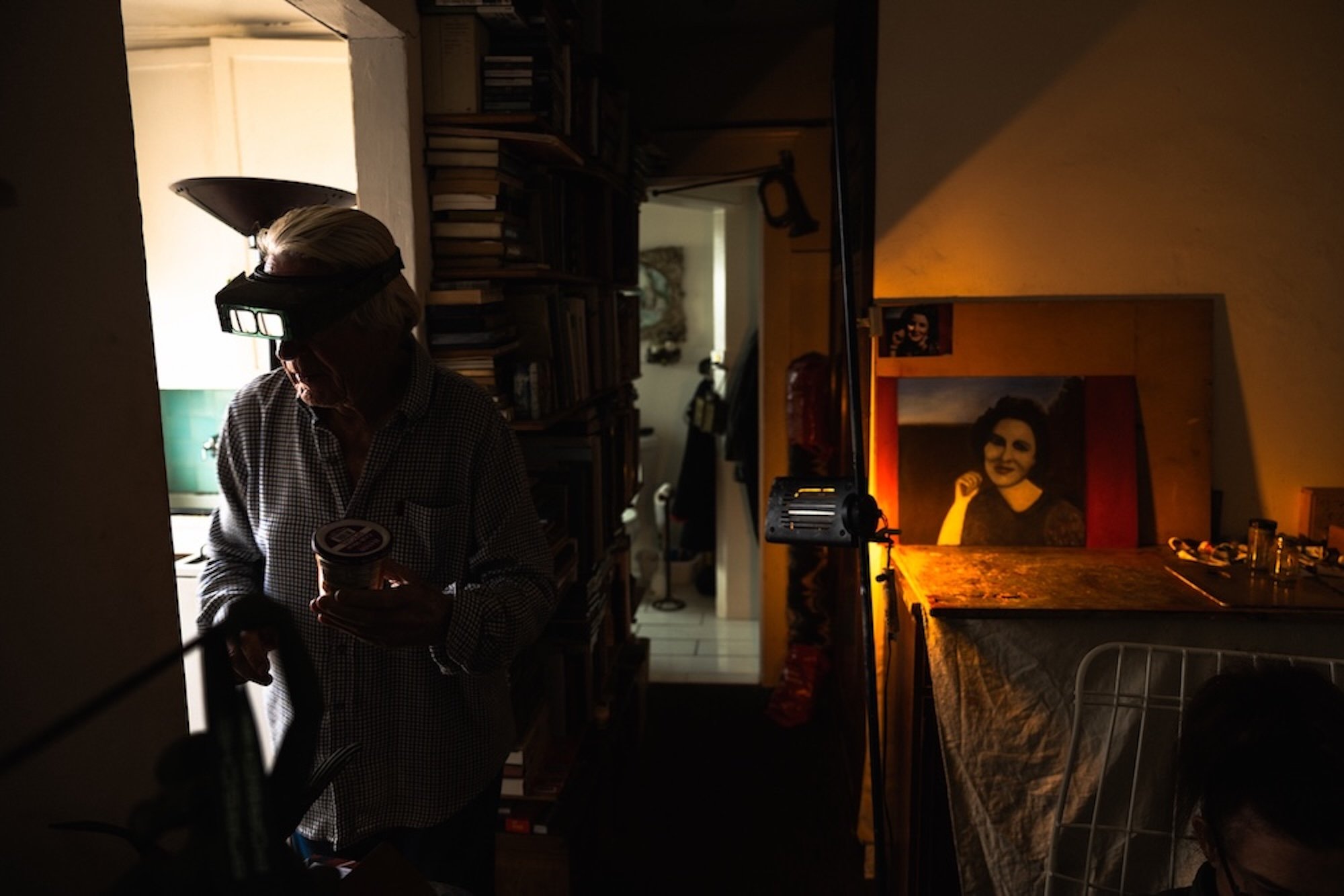
Klaus Hübner, 88, spent his childhood in eight orphanages in Berlin during World War II. Today, his home is a museum of memories
He greets me with a thick German accent and an offer of crab cakes and eggnog at noon on a Friday. A tool maker by trade, he still wears thick glasses that belong to another era. His friend of 24 years, Katherine, is here too — she comes often, functioning as the mother he never had.
In August of 1977, as the world mourned the loss of Elvis and headlines read “The King is Dead,” Klaus Hübner found himself at the beginning of a 48-year journey, gradually shaping a home that reflects the life he has lived.
Now 88 years old, Klaus spent his childhood between eight different orphanages in Berlin during World War II.
While Klaus himself never met his father, he was able to learn about his father's role as a wartime photographer and painter. Klaus is a painter himself, and attributes this skill to him.
Klaus proudly shows me a painting of the church near the home he shared with his foster mother, who died when he was five. Sent to Poland during the bombing of Berlin, he returned to find the church—and the entire street—reduced to rubble. The colorful painting, born from memory, stands in striking contrast to the black-and-white photograph of the church as it once stood.
Tucked into the corner of his room is a porcelain statue from Dachau, made in a Nazi-controlled factory near Munich that relied on slave labor from the Dachau concentration camp.
Klaus pulls out a stack of handmade postcards, some bearing his paintings, others his photographs. Among them is a postcard that Klaus took of the site of James Dean’s infamous car crash, alongside another showing the wreckage itself.
Klaus loved James Dean. When I asked him why, he simply said, “He was my idol. Some children loved singers; I loved James Dean.” That reverence, carried decades later, is a stark reminder of how deeply a life can resonate—especially with a child who had so few people to look up to.
All images and text were created with the subject’s knowledge and consent.